

This final memo in the series addresses how the success of a cleaning process is defined. Three elements make this possible: how residue samples are collected from the equipment surface, how residue limits are set for chemical and microbial residue, and which analytical and microbiological methods are used to measure against those limits.
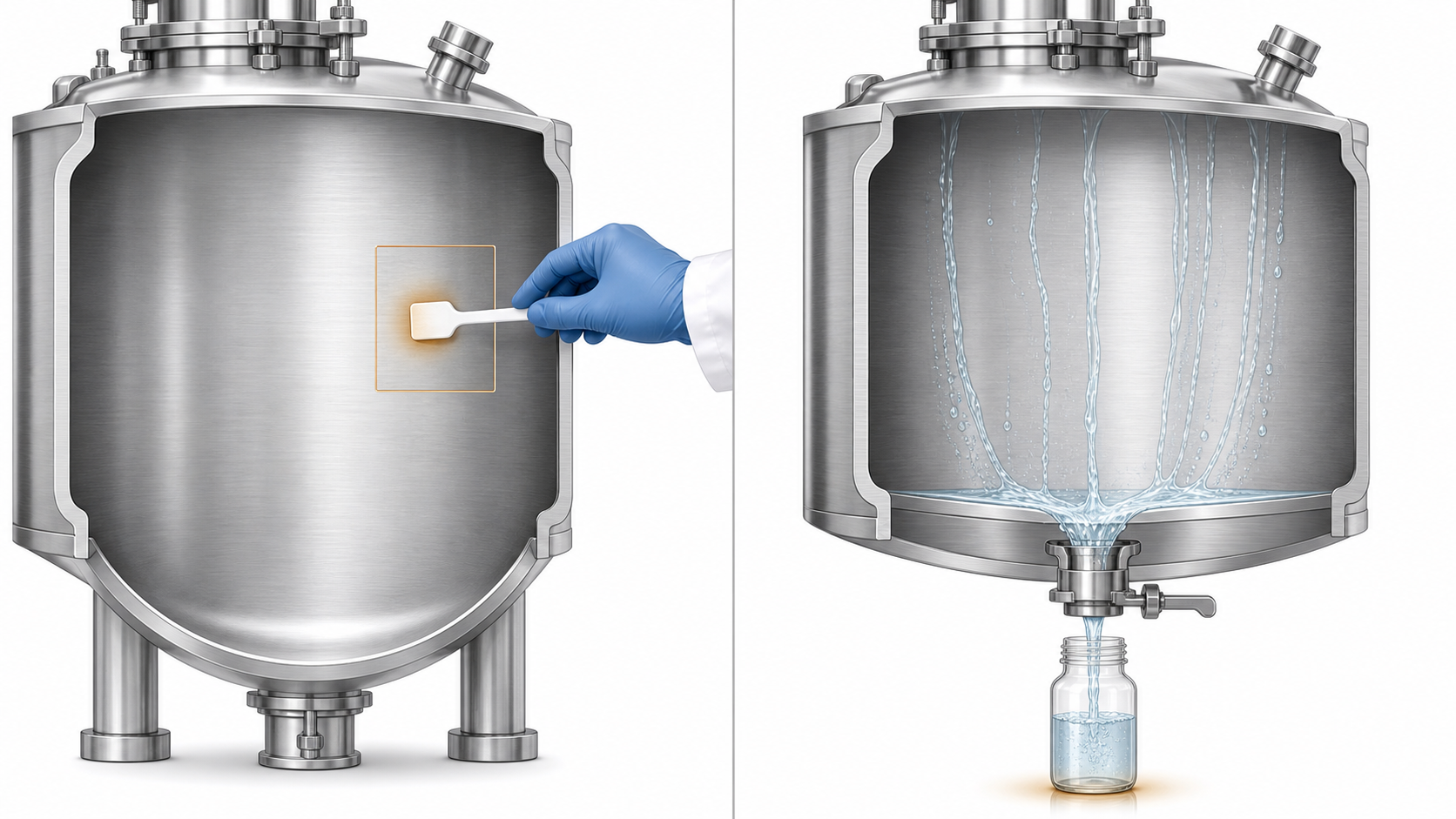
The first step in proving that a cleaning process works is defining the sampling technique. The two most common techniques are swab sampling (residue collected directly from the surface) and rinse sampling (an indirect method).
Chemical residue swab sampling uses a paddle-shaped swab. The paddle configuration is preferred because its flat, broad head maintains uniform contact pressure across a defined surface area, allowing consistent coverage of a pre-established swabbing template (typically 25 cm² or 100 cm², as specified in the protocol) and improving recovery reproducibility relative to smaller, rounded swab tips.
Swabbing is executed in a systematic, overlapping stroke pattern — horizontal passes followed by vertical passes using opposite faces of the paddle — with the swab pre-wetted in the qualified extraction solvent. The swab head is then transferred to a labelled container holding a known solvent volume for analysis. The rationale for selecting sampling locations, and its documentation, was covered in the October 2024 and November 2024 memos; a separate memo (December 2005) addresses how to determine the area to swab.
When it comes to swab sampling for microbial residues, the swab must be sterile and is typically a round swab. Also, for micro swabbing the area sampled is typically 25 cm2, since that is the area of a typical Rodac plate.
Rinse sampling involves collecting a sample from the final process rinse (FPR) or from a separate rinse cycle following the FPR, as detailed in the January 2009 memo. Of the two techniques, swab sampling remains preferred because it yields direct quantification of residue removed from the specific area sampled, whereas rinse results are diluted across the entire wetted surface and reflect only what the solvent happens to carry away.
Put simply, one would not judge whether a pan is clean by just inspecting the water draining from the dishwasher. Rinse sampling therefore serves a complementary role and is applied where swabbing is impractical — small-diameter tubing, complex geometries, and similar non-accessible surfaces. All samples must be uniquely identified, recorded on a sampling log, and delivered to the laboratory within the hold times validated for the analytical method.
And then we need to define how much residue may remain on an equipment surface without posing a risk to the next product manufactured — and, by extension, to the patient. Residues commonly tracked include the active ingredient from the previous product, the cleaning agent (if used), and microbial residue. Residue limits for the active and the cleaning agent are calculated; the formulae are given in the March 2025 memo.
It is now a settled principle that residue limit calculations should be health-based, a position reflected consistently in guidance from the EMA, PIC/S, and other authorities, and in consensus standards such as ASTM E3106. The remaining question is not whether health-based residue limits apply, but which additional criterion, if any, should be evaluated alongside them: the lower of the health-based and dose-based limits, the lowest of the health-based, dose-based, and 10 ppm limits, or the lower of the health-based limit and a visual residue limit. That determination cannot be made generically; it should be driven by the products actually manufactured at the site in question.
As a practical framework, a site manufacturing injectable formulations is best served by relying on health-based limits, given the route of administration and the correspondingly low tolerance for carryover. A site producing generic drug products of moderate to low toxicity would be better served by adopting the lower of the health-based and dose-based residue limits, or the lower of the health-based limit and a visual residue limit. Either way, the rationale for the criterion selected should be documented in the cleaning validation program so that the basis for the limit is transparent and defensible on inspection.
In biotech processes the protein generally is partially or completely denatured by the cleaning process itself, so the active molecule no longer exists in an intact, quantifiable form at the point of sampling. Total organic carbon (TOC) is therefore the attribute tracked — a non-specific but sensitive indicator of remaining organic material. Industry practice has commonly relied on broad default TOC limits for upstream and downstream operations.
For new molecules, where data to support a calculated limit are not yet available, a workable interim approach is the three-tiered default limit structure described in the February 2017 memo. This provides a defensible starting position that differentiates between process stages and expected residue levels, while allowing the defaults to be replaced with calculated, product-specific residue limits once sufficient process and analytical data exist.
Chemical cleanliness is only half the story. The other half is microbial contamination — bioburden for non-sterile formulations, and bioburden and endotoxin for aseptic formulations. Default bioburden and endotoxin limits are the industry standard. More information can be found in our May 2025 memo.
Where a formulated detergent is used, a residue limit must be set. The supplier’s toxicological data supports a PDE, from which a limit is calculated in the same manner as for the active.
Once a residue limit is calculated, the next question is whether an analytical method can reliably measure the residue collected. Methods fall into two broad categories. Specific methods — HPLC, UPLC, LC-MS — quantify a defined molecule, typically the API. Non-specific methods — TOC and conductivity — measure a property of a class of residues rather than a specific molecule.
Two parameters deserve particular attention. The first is the limit of quantitation. Residue limits may fall as new molecules are introduced into a facility, and a limit can drift below the LOQ of the established method; the LOQ must therefore sit meaningfully below the acceptance limit, typically in the range of 10–30% of it, and should be re-examined whenever the product mix changes.
The second is the recovery factor, which must be determined and documented for the specific combination of residue, surface, and sampling technique in use. Recovery is surface-specific — stainless steel, PTFE, glass, silicone, and Hastelloy all may behave differently — so each material of construction in the equipment train requires its own recovery factor, or a worst case must be justified. Recovery is equally residue- and method-specific; a factor generated for one residue or one method cannot automatically be carried across to another.
The strength of a cleaning validation program lies in the coherence of these links — sampling technique, residue limits, and measurement methods. Where you sample decides what the result tells you. The limit decides what that result is judged against. The method decides whether the comparison means anything.
Copyright © 2026 by Cleaning Validation Technologies


