

In earlier memos in this series, we made the case that equipment and product are the two foundational pillars of cleaning validation. This memo turns to the element that binds them together — the cleaning process itself. A well-designed cleaning process takes into account three elements: the soil to be removed, the chemistry involved in soil removal, and the mode of cleaning. This memo examines each in turn.
Every cleaning process begins with a single question: what soil am I trying to remove? That soil is typically the manufactured product. The soil on an equipment surface may be freely soluble in water (or other solvent), poorly soluble, or effectively insoluble. It may be a single molecule — as is often the case in drug substance manufacturing — or a complex mixture of an active ingredient and its excipients, as in a formulated drug product. Understanding the soil, and in particular how its components behave both individually and together, is the true starting point of cleaning design.
A common misconception in formulated drug product cleaning is to treat the active ingredient as the only residue of concern. In practice, every excipient in the formulation is a potential cleaning challenge — and very often, the excipient is far harder to clean than the active itself. Examples range from lubricants (magnesium stearate), to polymers (HPMC, PVP), to colorants and coating materials. A cleaning process designed solely around the active ingredient may leave excipient residues behind, which could trap the active on the surface. Therefore, the right starting point is often to identify the most difficult-to-clean component(s) of the formulation and design the cleaning process around these component(s)/molecules.
Once the soil is characterized, the next decision is how to remove it — which begins with the choice of cleaning agent. In drug substance manufacturing, organic solvents dominate. The same solvent used in the reaction step is often used for cleaning, drawing on the principle of like dissolves like — matching solvent polarity to soil polarity.
In biotech and vaccine manufacturing, caustic aqueous solutions are the standard. Sodium hydroxide hydrolyzes peptide bonds and disrupts protein structure, converting stubborn protein soils into soluble fragments. And it is cheap and easily available.
For most formulated drug products, aqueous cleaning — with or without a formulated detergent — is the standard approach. Whether water alone is sufficient or a detergent is required, comes back to the nature of the soil: can the soil be removed by dissolution alone? The soil has to be water-soluble, or the solubility could increase with the use of heat and/or mechanical action so as to remove the soil. Since most drug product soils are at least partially hydrophobic, water alone will not work and therefore the use of formulated detergents is the preferred approach.
Formulated detergents work by changing the chemistry of the soil itself — ionizing, hydrolyzing, or emulsifying residues so that they become hydrophilic and rinse cleanly away. Selection of a formulated detergent depends not only on the soil being removed but also how it will be removed – manual cleaning or automated CIP. To take an example:
This is why CIP detergents are deliberately formulated to be low-foaming, while manual detergents often go the other way.
It is tempting, in the interest of simplicity, to standardize on a single mild “universal” detergent across a site. It reduces cleaning agent SKUs, simplifies training and streamlines procurement. And in some cases, based on the soils encountered at the site, it may even work. The flip side is that it is a compromise that makes cleaning some of the soils inefficient. Think of an assembly line. A single adjustable spanner can turn almost any nut, and for the occasional job it is perfectly adequate. But no assembly line operator, working at pace, would choose to work with an adjustable spanner. Detergents are no different. The better approach is a portfolio of detergents matched to the soils encountered at the site.
Making the Process Efficient: The TACT Framework
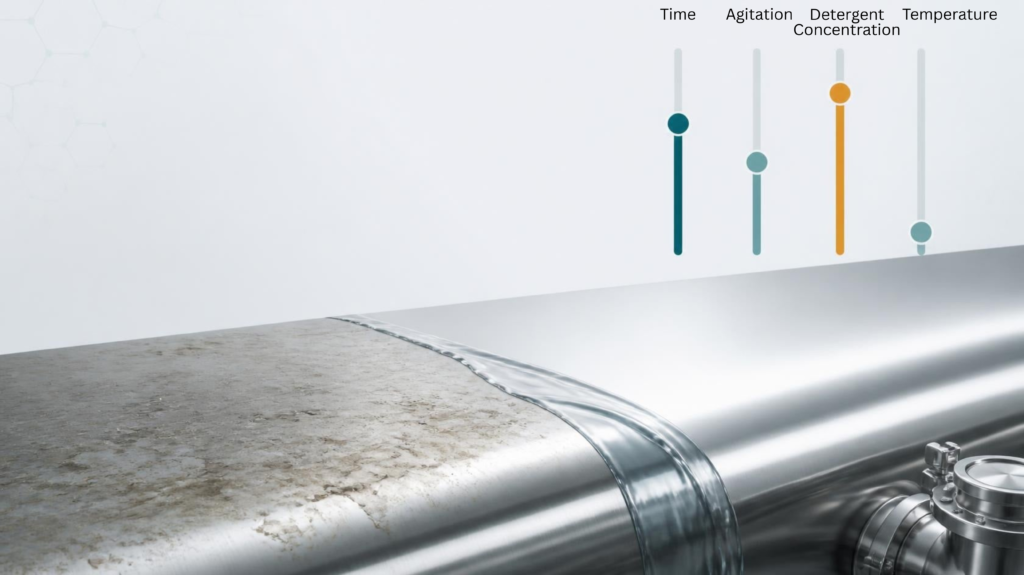
With the soil understood, the chemistry chosen, and the mode of cleaning set, the final task is optimization. There are four variables that any cleaning process can leverage, commonly known as TACT:
These variables are levers that can be traded off against one another. If we lower the concentration, we can compensate with longer time or higher temperature. With limited mechanical action, as with complex CIP geometries, we can lean harder on more aggressive chemistry. A well-run Design of Experiments (DoE) can be the most effective way to establish an optimum operating mix of ranges for each of these variables, rather than relying on trial-and-error or vendor defaults.
The purpose of this memo has been to highlight the central role that cleaning process design plays in cleaning validation. The soil defines the problem; the chemistry provides the tool; the mode of execution — manual or automated — determines how that tool is wielded; and TACT provides the levers to optimize the outcome.
The September memo will cover how residue limits can be calculated and its relationship to the analytical methods.


