

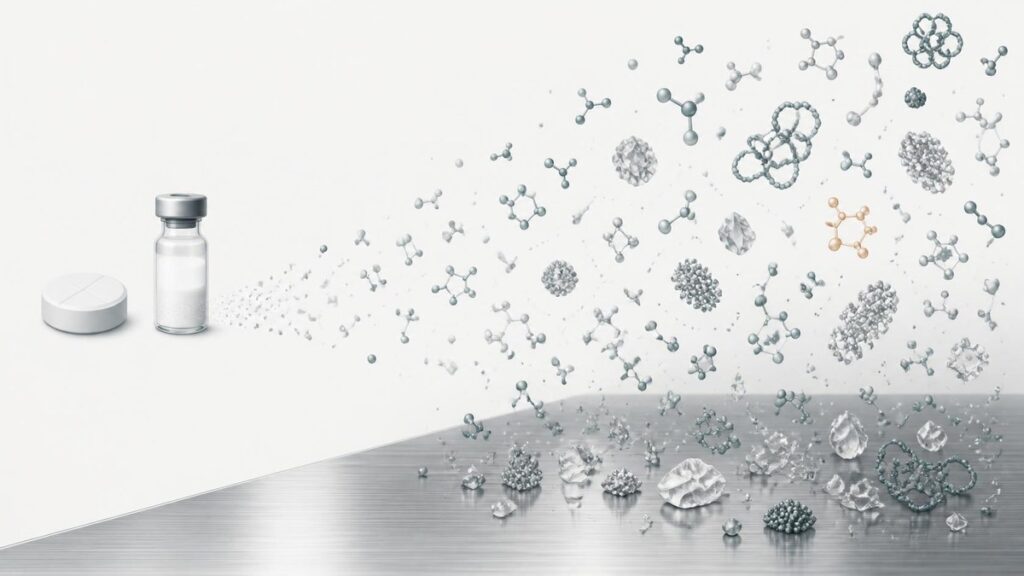
Part 1 of this series described product contact equipment as one of the core components of a cleaning validation program. We now turn to the second core component: “Product”. If equipment defines the surface to be cleaned, then the product answers the questions “what am I cleaning off that surface?”, thereby defining the residues to be controlled. These two components are inseparable: the same soil can behave very differently on different surfaces, and the same surface can present very different cleaning challenges depending on the soil left behind.
A robust cleaning validation program therefore begins by identifying, characterising, and prioritising the soil on the surface before any limits are set or analytical methods developed. Getting this step wrong propagates errors through every subsequent decision — worst-case product selection, sampling strategy, method development, and acceptance criteria — leaving little genuine confidence that residues are consistently brought down to a level that is safe for the patient receiving the next product manufactured on that equipment.
A cleaning validation program that treats product as a single, static entity — typically the labelled active ingredient — will inevitably miss residues that matter and may validate against the wrong target altogether.
In practice, “product” is rarely a single molecule. For a drug product, it is a composite of the active ingredient, excipients, and degradation products formed during processing. For a drug substance, it is a composite of the API, process intermediates, reagents, catalysts, and/or solvents. And, in some cases, materials that were never intended to be present at all. Each of these residues carries its own solubility, adherence behaviour, toxicological profile, and analytical detectability, and each may respond differently to a given cleaning cycle.
Product — The Soil
In any cleaning validation program, the “product” soil is of primary concern from a regulatory and from a quality perspective. The residue left after cleaning of that soil differs based on whether the facility manufactures drug substances or drug products or non-drug products. Certainly the API and its residue after cleaning is a major concern because residue limits are generally set for that molecule after cleaning.
Excipients
Excipients deserve similar attention. While typically less of a hazard concern than an active ingredient, certain excipients — preservatives, surfactants, colorants — can present cleaning challenges of their own due to poor solubility, surface adherence, or interaction with cleaning agents. Those cleaning challenges due to excipients may affect the levels of APIs left as residues. A program that evaluates only the active ingredient while ignoring difficult-to-clean excipients is incomplete.
Small Molecule Drug Substance Considerations
For small molecule drug substance manufacture, risk also arises from synthesis steps upstream of the final API — intermediates, reagents, catalysts, and process-related impurities may all persist on equipment surfaces and require consideration. Risk also comes from low-yielding steps. When a synthetic step proceeds with low yield, a substantial fraction of the starting material is not converted to the desired product and remains in the process stream as unreacted material, side-products, or unknown impurities. These residues may be poorly characterised toxicologically, may not be detected by API-focused analytical methods, and can accumulate on equipment surfaces. The cleaning program must therefore account for the full material balance of each step, not just the target molecule.
Large Molecule Considerations
Large molecule manufacture presents a fundamentally different picture. The intact product itself is often not the most challenging residue to control — proteins are readily denatured by the alkaline, high-temperature cleaning cycles typical of biologics facilities. The relevant question, therefore, is not simply “is the protein removed?” but “has the protein been fully denatured, or only partially?”.
This distinction matters because it determines the nature of the residual risk. Partial denaturation is arguably the worst case: the molecule may retain some structural features capable of eliciting a biological response, while no longer being detectable by activity-based or product-specific analytical methods. A fully denatured protein, by contrast, has lost its biological activity, but the risk to patient safety shifts to the potential immunogenicity of the denatured protein fragments carried over into the next batch. Smaller fragment are of lesser concern, while aggregates are of more concern as they are well recognised as immunogenic trigger, even trace quantities can be clinically significant.
The regulatory expectation in many biologics contexts is therefore to demonstrate removal of protein as a generic residue (e.g. by TOC), rather than as the specific API. However, this simplification does not eliminate risk. Aggregation behaviour, adherence to stainless steel or single-use surfaces, and the immunogenic potential of even trace protein residues mean that the cleaning strategy must be built around a nuanced understanding of what actually persists on the equipment — and in what form — rather than simply the labelled active.
Why This Matters
The cleaning process must be developed and validated to remove residues to below a demonstrably safe limit. Everything that follows in a cleaning validation program —analytical methods, worst-case selection, and revalidation triggers — depends on a complete understanding of what the soil actually is, how it behaves on the equipment surface, and what risk residues of the soil poses to the next product manufactured. Without this foundation, the rest of the program is built on assumptions rather than evidence.
The August & September memo will continue the discussion of this core component, the Product, with emphasis on cleaning process design, how residue limits are established for small and large molecules, and how products can be grouped to reduce cleaning validation workload without compromising rigor. Together, these topics define what “knowing your product” really means in practice.
© 2026 Cleaning Validation Technologies


