

A cleaning validation program is built on three core components — equipment, products, and associated analytical and microbial methods. Together, they form an interconnected system: equipment defines the surface to be cleaned and sampled, product defines the residue to be controlled, and analytical and microbial methods define how cleanliness is measured and verified. These components have traditionally existed in silos, but a well-designed cleaning validation program brings them together into a single, governed lifecycle framework. This three-part series examines each component in turn. Part 1 covers equipment, Part 2 will address product, and Part 3 will cover analytical and microbial methods. The principles discussed apply across drug substance and drug product manufacturing, for both small- and large-molecule products.
Equipment — The Surface
In any cleaning validation program, the equipment surface is the base element. Everything else follows only after the surfaces have been properly characterized. Destin LeBlanc’s cleaning memos on swab and rinse sampling, swab location selection, indirect product contact surfaces, and dedicated equipment together define what “knowing your surface” really means in practice.
The selection of swab locations is one of the most important decisions in the program. An inadequately justified sampling location — chosen at random rather than through scientific justification — can pass a validation run while leaving unacceptably dirty surfaces unsampled. The rationale must explain why each location is worst-case, what makes it difficult to clean, and how the overall plan provides confidence beyond the specific points sampled. The October 2024 memo on Selecting Swab Sampling Locations emphasizes that worst-case locations may be driven by geometry, flow dynamics, material, surface texture, or residue accumulation behavior. The November 2024 follow-up stresses that the documentation must be complete enough to withstand regulatory inspection without later reconstruction.
Indirect product contact surfaces (IPCSs) add another important dimension. The memos on Residue Limits for Indirect Product Contact Surfaces [May 2021] and Risk Assessment for Indirect Product Contact Surfaces [June 2021] make clear that surfaces such as isolator walls, enclosures, and other non-product-contact structural parts are not automatically outside the cleaning validation scope. They require a documented risk assessment to determine whether residues could migrate into the product through airflow, condensate, or incidental contact during assembly. The key scientific question is simple: can residue on this surface reach a product contact surface and then be transferred to another product?
Dedicated equipment and campaign manufacture change the scope of the program as well. As discussed in Campaigns and Dedicated Equipment [November 2000], once equipment is dedicated to a single product or product family, the primary concern is no longer API cross-contamination, but rather degradation products, cleaning agent residues, and microbial control during hold times. That shift must be explicitly recognized and scientifically justified.
CIP Loops
No discussion of equipment surfaces is complete without Clean-In-Place systems. Unlike disassembled equipment that can be visually inspected and swabbed, CIP loops contain pipelines, vessels, pumps, and valves that form a largely inaccessible network of product-contact surfaces. For that reason, while drain‑point rinse samples obtained during protocol runs remain an important part of the cleaning validation program, reliance solely on a drain‑point rinse sample is not sufficient and must be supported with additional justification and data as discussed below.
A critical physical reality governs rinse sample interpretation in a loop: residue from early upstream sections is progressively diluted as the rinse travels through the system before reaching the drain-point collection location. The final rinse sample therefore reflects a diluted, averaged concentration across the loop, not the highest residue burden at the hardest-to-clean upstream location. The memo on Limits for Rinse Grab Samples addresses this directly through the selection of the volume parameter F in setting rinse limits. For this reason, rinse testing should be supported by spray coverage studies such as riboflavin tests and by monitoring critical CIP parameters including temperature, flow velocity, cleaning agent concentration, and cycle time.
The Surface as a Living Record
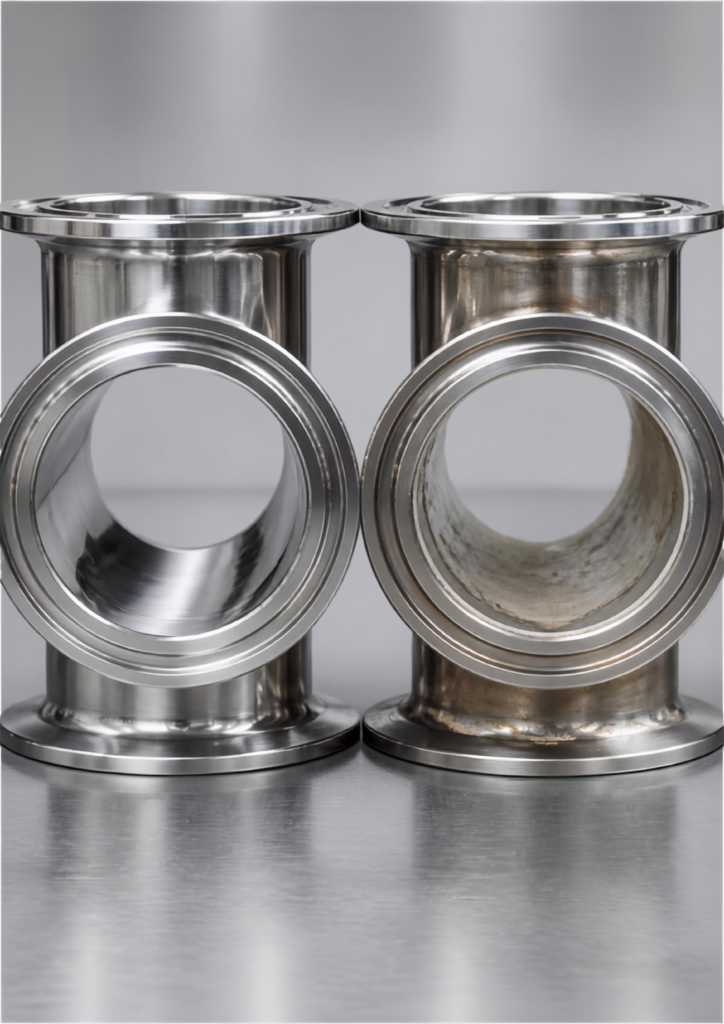
The equipment surface — whether a gasket, an IPCS, a dedicated equipment train, or a CIP loop — is not information to be captured once and forgotten. It changes with modifications, ages with use, and affects every downstream cleaning validation decision. Aging deserves particular attention: stainless steel surfaces develop micro-pitting and surface roughness over years of cleaning cycles, thermal cycling, and chemical exposure, increasing the capacity of the surface to retain residue in ways that were not present at the time of original cleaning validation. Elastomeric components such as gaskets and seals are especially susceptible — hardening, cracking, and surface degradation can create sites to harbor both chemical residues and microbial contamination that a validated cleaning procedure may no longer adequately address. A periodic surface condition assessment — linked to the equipment’s maintenance and qualification records — is therefore not a discretionary good practice; it is a scientific obligation to confirm that the cleaning validation program remains valid for the surface as it exists today, not as it was characterized at commissioning. A change in geometry may alter swab location selection, a new material of construction may affect residue retention, and a piping modification may change flow dynamics and rinse interpretation.
Full characterization and active management of the equipment surface record is not a preliminary step in cleaning validation – it is the discipline that holds the entire program together. Without it, limits are assumptions, sampling plans are conventions, and compliance is fragile. With it, every subsequent decision in the program stands on solid scientific ground.
© 2026 Cleaning Validation Technologies


