

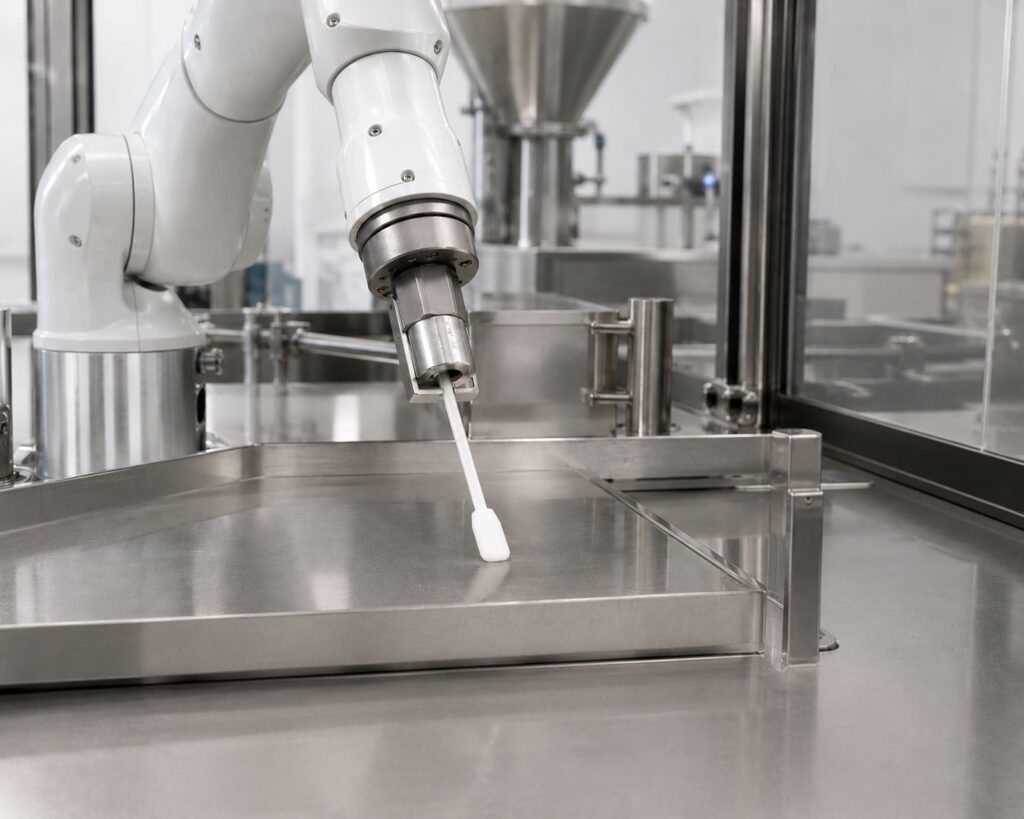
There generally have been two acceptable methods for sampling of equipment surfaces that involve removal of residues from the surface for subsequent measurement of those residues by a suitable analytical method. One is swab sampling (sometimes called direct surface sampling) and the other is rinse sampling (sometimes called indirect surface sampling). These have been discussed in earlier Cleaning Memos as well being covered in my training seminars/webinars. While some scientists state that swab sampling is preferred, my general assertion is that either (or both) could be preferred depending on the specifics of the situation.
Swab sampling has generally been a manual process, meaning that the swab operator is primarily responsible for control of the swabbing process to assure consistent results in terms of parameters like area covered and pressure of application. A key downside to manual swabbing is the sampling of surfaces in which the operator cannot practically or easily reach the surface for adequate sampling (because of the distance from the open manway to the surface location to be sampled). This issue more typically applies to large process vessels cleaned by an automated CIP cleaning process, but less so to equipment that is disassembled for manual cleaning. Two approaches to deal with the situation are (1) to have tank entry of the operator under defined safety tag out and lock out procedures and (2) to keep the operator outside the tank but sampling internal surfaces with a swab at the end of an extension pole (sometimes called remote swabbing). For tank entry the operator swabs as is ordinarily done; for the extension pole, the operator provides movement of the extension pole to allow contact with the surface and then move the swab across the surface to be sampled.
The main downside with the tank entry approach is the safety concern with the operator entering the vessel; there may also be issues related to the ability of the operator inside the tank being able to access all surfaces which have been identified as critical sampling locations. With the tank entry sampling, it also may be appropriate to clean the vessel again before releasing it for subsequent use (because of possible re-contamination concerns due to the presence of the operator inside the tank).
The main downside with the extension pole approach is inherent variability in controlling the area to be sampled and the pressure of the swab head against the surface. Controlling the area sampled to no more than a 10% variation is difficult enough when the operator is directly handling the swab. It becomes much more difficult if the movement of the swab is controlled by the swab operator using an extension pole where the operator is several meters away from the surface being sampled. This variability is more due to the operator control as compared to any variability attributed to any torque effects associated with the length of the extension pole.
This brings us to the main subject, that of performing remote swabbing with a robotic device. There is a device develop by SwabBot company to address this remote sampling. The major advantages of this robotic system are (1) avoiding tank entry and (2) obtaining more consistent swabbing due to better control of the area sampled and of the pressure of the swab on the surface. Called “SWAB-E”, it consists of three main parts:
The swab is wetted (as traditionally done), and then attached to the robotic fixture. The robotic fixture is placed at the end of the arm, then introduced into the vessel and moved to contact the surface around the area to be sampled. The arm with the robotic fixture is introduced into the tank to rest on the equipment surface, allowing a central “open” area which is to be swabbed. The current maximum swab area is 7 cm X 7 cm (although based on client input SwabBot may expand that to 10 cm X 10 cm). After completion of the robotic sampling, the fixture is removed from the tank and the swab removed from the fixture so it can be processed as is typically done. The maximum distance for swabbing is 17 feet horizontally and 30 feet vertically. This difference is due to the maximum allowable torque on the arm for consistent results. Swabbing is best done on flat surfaces so that the swab fixture has a consistent resting place on the equipment surface; gently curved surfaces may also be sampled.
The SWAB-E is currently being evaluated by six companies, all of which are in Biopharma. Commercialization by SwabBot is expected later in 2026.
This information is based on information provided by SwabBot, which includes a PDA Journal publication based on a laboratory study comparing traditional manual swabbing, manual remote sampling and direct robotic swab sampling.
Notes:
© 2026, Cleaning Validation Technologies


